Kingdom Farming

Parable of the sower and seedMark 4_26-34

The fourth chapter of Mark’s gospel could be described as The Lord’s Guide to Kingdom Farming. Jesus’ teaches with parables involving fertile soil, sunshine, the sower and of course seeds. In the first of the farmer parables, the sower willfully scatters seed in all types of soil. Some of the seed grows, some struggles against other unwanted plants and there is a portion that seems to have little chance at all. Yet the sower is always generous with the seed of God’s Word.

In the text for today, there is little doubt that the farmer takes no credit for the sprouting of the seed. Instead, the farmer sleeps and rises with the day and night, simply having faith that growth will occur. The farmer in God’s kingdom understands powers beyond his own are at work causing the seed to sprout and grow. When the time is right he takes up the sickle and reaps the harvest. This cycle is but one way of recognizing how the Holy Spirit moves throughout the world as disciples of Jesus carry out the farmer’s duty of scattering seed.

As Christians scatter the Word among the mission fields, faithful disciples resemble the farmer in the parable. In faith, the Church sleeps and rises not knowing how it is that God causes the seed to sprout and grow in the hearts of those who receive the Word. We are often surprised at how quickly some seeds sprout. Suddenly, new members enter the community of believers and take their place at the table where God continues to feed and nourish their faith. Other seeds seem to take a long time to sprout and grow; it could be that those who initially sowed the seed have moved on to new fields well before growth becomes evident.

Jesus uses this parable to teach the Church that no matter the time or place, ours is the duty to be generous in the planting of the seed of God’s Word. Our mission is to be kingdom farmers and plant seed. God causes growth; the measure of our success is in the planting. As an illustration, the second parable offered today teaches us that God causes the seed planted by God’s people to grow far beyond what we are able to comprehend.

Jesus asks, “With what can we compare the kingdom of God? It is like a grain of mustard seed, which, when sown on the ground, is the smallest of all the seeds on earth, yet when it is sown it grows up and becomes larger than all the garden plants and puts out large branches, so that the birds of the air can make nests in its shade.” With such an illustration, we ought to recognize that it isn’t the size of the congregation or the number in a group that is important. It is the faith in which we sow our seed which is essential to kingdom farming.

Often, in the church that is sleeping and rising with the night and the day, small groups of believers gather to pray. Eventually, they recognize the presence of the Holy Spirit and begin to put faith into action. Soon new ideas sprout and ministries for the sake of others emerge. The mustard seed is the smallest, yet it miraculously grows and become the largest of shrubs. Likewise, we never know which of our small ideas will grow into vibrant ministries to feed and shelter those within the kingdom who have need. Again as Jesus says, “He who has ears to hear, let him hear.”

Posted in Discipleship, Gospel According to Mark | Tagged , , , , , , , , , | Leave a comment

Let Your Light Shine

parable of the lampMark 4: 21-25

At the onset of my seminary instruction, I wasn’t accustomed to leading musical portions of liturgy during worship. I’ve never been a musician and to this day I do not read music or play any sort of instrument. Still, I dearly love leading my congregation through the liturgy of our worship, but back in the beginning such was not the case.

The first time I was scheduled to intone the liturgy, my supervising pastor suggested that I run through everything a few times with our music director. Following a few vocal warm ups, the organist played the psalm tone on his piano as I sang rather quietly through the six verses of Psalm 1. After he helped build my confidence, I rather robustly sang out the entire Kyrie and Hymn of Praise in the solitude of his office. After tackling the psalm one more time, the pastor bolted into the room and asked if I would please turn off my wireless microphone. Little did I know that, for about fifteen minutes I had been serenading the group gathered for prayer in the church nave.

As I look back on this event, I realize that had I known the microphone was switched on I would not have made such a public display. Rather, I would have quickly switched it off and continued sheepish with my practice. Instead, I was able to share the good news of God’s saving grace boldly. Even if my voice is not on par with those of qualified musicians and vocalists, there could be no denying the truth of God’s promises kept through his Son Jesus Christ.

Jesus asks his disciples, “Is a lamp brought in to be put under a basket, or under a bed, and not on a stand?” Certainly not! God blesses the Church with the most precious treasure there is, the gospel of our Lord Jesus Christ. Each baptized child of God is therefore called to give witness to the wonders of God’s mercy and grace by sharing this gift with the world. With the baptismal rite of the Lutheran Church, we exhort the newly baptized to “Let your light so shine before others that they may see your good works and glorify your Father in heaven.” (Lutheran Book of Worship)

In a world fallen into sin and broken beyond human repair, the only hope for salvation comes through Christ and believing that through him, God indeed keeps his promises. Jesus of Nazareth is light and life for the world. Baptized into his death and resurrection, the light of Christ dwells within God’s people. Shine your light so that through the darkness of the world, all may finally see the glory of the Father and enter the gates of our eternal home.

Posted in Discipleship, Gospel According to Mark | Tagged , , , , , , , | Leave a comment

Parable of the Sower

parable of the sowerMark 4: 1-20

Jesus’ Parable of the Sower is perhaps is best known and most beloved of parables. When sermons based on this text are preached, it isn’t long before congregations begin to give thanks that they are indeed good soil. After all, it is not as if we are like the rocky ground of society; we are at worship on Sunday. We are hearing God’s Word and singing his praise. By all appearances we assure ourselves that we understand the parable, but appearances aren’t always what they seem.

As the seed of God’s Word is scattered among the congregation, how often does it fall upon those making up the pathway. Yes, they are in worship, but some come not to see, but to be seen. Throughout the life of the Church there have been many who see the Sunday gathering as a way of self-promotion, a means to broaden their standing within the community. Such “Look at me” moments allow the devil’s minions to snatch the seed and devour it as soon as it falls upon them.

Seed is also scattered upon the rocky ground of many who hear the preaching of God’s Word, but only a few times each year. Worship is not a habit for them; they don’t understand the liturgy and have shallow sense of the centrality of the sacraments. For those lacking the roots of faith, Holy Baptism and Holy Communion are simply things we do in order to demonstrate our beliefs. Sadly, it isn’t long before worldly desires become more attractive. Life among God’s people is replaced with the pursuit of earthly pleasures causing the roots of faith to wither and die.

Some of the sower’s seed also falls upon hearers made up of thorny soil, those who hear the Word, yet their minds are preoccupied with other things. “The music is too fast or slow.” “The room is too cold or warm.” “Where is the money going to come from?” “I’m not giving my money to that!” Statements such as these are made through selfish desire and inward focus. They are weeds rooted in once fertile ground, choking the vine of faith until it is no longer the gospel, but other words of self-centeredness that resonate in the listener’s ear.

Finally, Christ assures us the seed of God’s Word also falls upon good soil, those with discerning minds and compassionate hearts. Such people receive the gospel truth and put it into action. It doesn’t matter whether or not personal preferences are met; consideration for others outweighs the desires of self. These are the faithful disciples, ignoring Satan’s attempt to thwart their receiving the gospel with joy so they may put faith into action upon their hearing. Inconveniences and discomforts may present themselves, but they are no match for joy of realizing the scope and depth of God’s mercy and grace.

Only seed that falls upon good soil will produce fruit for God’s kingdom. As disciples of Jesus, we must learn to recognize when we fall short, we can confess our sin and live in faith and love.  Through Christ, God transforms us into soil fit for the planting of his Word. Then at last, in our mission and ministry are we able to yield a harvest. “He who has ears to hear, let him hear.”

Posted in Discipleship, Gospel According to Mark | Tagged , , , , , , | 2 Comments

House Divided

house dividedMark 3:20-35

One does not have to look too closely to see the worst elements of humanity at work. It seems that in our fallen and broken world there is more than ample supply of unsavory elements working against the goodness of God. It’s not uncommon to hear of unidentified scam artists taking advantage of the eldest and weakest. Alerts and announcements exclaiming “You’ve won the (name your foreign country) lottery!” or “You’ve been chosen!” usually mean you’re going to be duped if your respond. Sadly many do respond and experience great losses. Preying upon the elderly and weak is certainly sinful, but it’s not unforgivable. There is, however, one sin that God will not pardon.

As the news spread that Jesus was casting out demons and unclean spirits, the religious leaders who enjoyed their status became jealous and viewed our Lord as a threat to their lofty position in society. They also took great exception to his teaching which exposed their own as faulty and self-serving. In order to stop the momentum of Jesus’ message, some Pharisees asserted that he himself was demon possessed and that is why he was able to expel evil spirits from the hearts and minds of others. Jesus, however, exposed this plot of the Pharisees by pointing out how ridiculous it would be to consider Satan to be working against himself.

Jesus says, “If a house is divided against itself, that house will not be able to stand. And if Satan has risen up against himself and is divided, he cannot stand, but is coming to an end” (Mark 3:25-26). One cannot build himself up by tearing himself down; it just doesn’t make sense. It would make no sense for Jesus to be using the powers of evil to rid God’s people of evil. Taking it a step farther, Jesus also points out to those who would accuse him that God will not forgive anyone who commits blasphemy against the Holy Spirit in order to suit their own purposes. Doing so means willfully and completely rejecting the power of God’s saving grace.

Corruption runs rampant throughout our world. It even extends into the Church. There are those who would call themselves evangelists, yet prey upon the most unsuspecting believers. This is one harsh reality of sin, but it is not unforgivable. Because Jesus remained obedient to God even unto death, giving his life as ransom for sin, forgiveness and reconciliation with God is possible. Does sin exist within the Church? Certainly it does. Can such sin be forgiven and sinners be saved? Absolutely! For this reason we pray:

Gracious Father, we pray for your holy catholic and apostolic Church. Fill it with all truth, in all peace. Where it is corrupt, purify it; where it is in error, direct it; where in anything it is amiss, reform it. Where it is right, strengthen it; where it is in need, provide for it; where it is divided, reunite it; for the sake of Jesus Christ, your Son, our Savior. Amen.


Photo:  PPG Square, Pittsburgh, PA.  August 2012

Posted in Forgiveness, Gospel According to Mark | Tagged , , , , , , , , | Leave a comment

Called by Christ

calling apostlesMark 3: 7-19

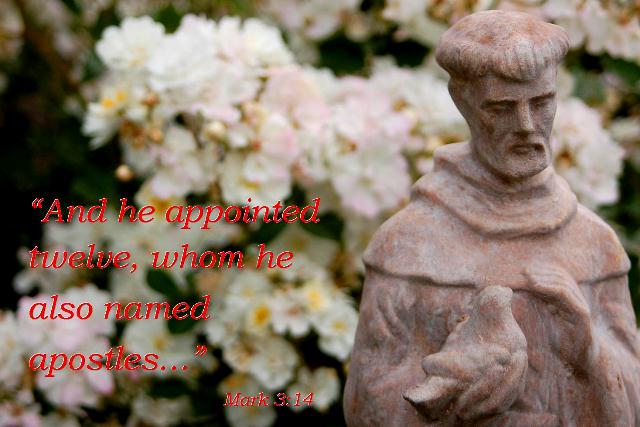
As Jesus taught God’s people with the authority of heaven, showed compassion on the weak and marginalized, and worked healing miracles to restore the lives of those in need, the crowds following him quickly grew larger. Within these crowds were people with great need, those who were curious, those who challenged Jesus’ authority and many others who followed Jesus and learned from him the way of discipleship. Of these followers, Jesus called out twelve, setting them apart from the rest in order to prepare them for the task of establishing Christ’s Church on earth. Jesus set them apart and began teaching them the ways of God’s kingdom, opening their minds to the mysteries of heaven.

Jesus gave the apostles authority to preach and to teach. He gave them power to heal, to cast out demons and taught them what it means to put the needs of others before their own. It was a difficult lesson that took time, but each of these men (except for the one who would betray him) would serve as representatives of Christ proclaiming the forgiveness of sin, teaching others the ways of God and sharing the good news of salvation while tending to the needs of God’s children.

God continues to call people out of the crowds and separate them for the sake of the gospel. In many instances, Christ calls from the crowds those least expected to do extraordinary things for the sake of others. It is still a difficult lesson that takes time. Upon their ordaining, God bestows authority and power to accomplish the same ministry as the twelve so long ago. He gives them courage and the will to go into the world and make disciples, to cast out demons, heal the sick, proclaim forgiveness of sin, baptize and preside at God’s table. Jesus calls the ordained to tend the flocks and feed his sheep. As we do these things, the Church of Christ grows.

The crowd that followed Jesus is the same crowd that gathers in churches and wherever the gospel is proclaimed. Pews, chairs and halls are filled with the marginalized, the needy, those who desire to learn more of the mysteries of heaven, and even some who would challenge the shepherd’s authority. Those who have been called and separated from the crowds must bear with that which is most often inconvenient. They willingly choose to deny their selves to take an opportunity of doing for others. Those who go about doing the work of God must learn to expect hindrances from some and overcome stumbling blocks of others. Yet, Christ calls whom he will; for his grace is his own.

May the Lord call and send forth more and more of those open to serving him through this blessed work. May the Church continue to love and support those called by Christ and together serve as witnesses to the world of God’s saving grace.

Posted in Discipleship, Gospel According to Mark | Tagged , , , , , , , , , | Leave a comment